



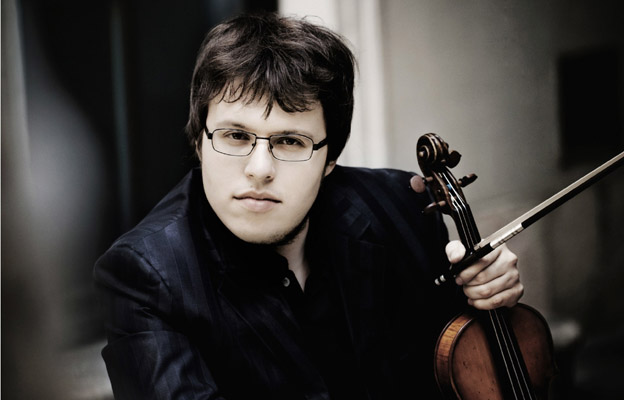
Thomas Albertus Irnberger
(c) Irène Zandel
Your new album ‘Johannes Brahms – Robert Schumann – Sonatas for Viola and Piano and Fairy Tale Pictures,’ is already your 75th release—hardly imaginable for a young violinist like yourself. Violinist? Are you running out of violin repertoire? Aren’t there still some important recordings missing, for example, Bach? What’s still missing?
I recorded the solo works of Johann Sebastian Bach when I was 19. Ivry Gitlis and Jörg Demus, who heard them at the time, urged me to release the CD. Shortly afterward, I began experimenting with the SACD format, which captures the spatiality that solo works require even more effectively. Recording Bach again has been repeatedly postponed, even though I have performed the solo sonatas and violin concertos publicly many times. But next year it will finally happen. Already recorded and in the pipeline are the famous Bruch Concerto, Chausson’s Concerto for Violin, Piano, and String Orchestra, and his concert piece Poem. In Israel, the Glazunov, Khachaturian, and Tchaikovsky violin concertos were planned for March 2026. The war has made that impossible at present.
 The repertoire for the violin is endless. Bartók, Shostakovich, and Wieniawski are on my wish list for the near future. How long have you also been playing viola, though you’ve kept it out of the public eye?
In recent years, I have regularly performed viola concertos publicly, primarily during Advent, and I particularly enjoy playing Telemann and Hoffmeister.
How can we imagine switching between violin and viola to master both instruments at this highest level? Do you put the violin away for a while? And how do you practice that technically?
Switching from violin to viola and vice versa poses absolutely no difficulties for me. It’s all in my head, simply a matter of rethinking from the G clef to the C clef. My height of 1.92 meters and my long fingers also work to my advantage; they move just as virtuously on the viola as on the violin.
Would it theoretically be conceivable for you to play both violin and viola in a concert? Perhaps with an intermission?
In the past, as I mentioned, I’ve always played both instruments in one concert around Christmas time: Telemann on the viola in the first half, Vivaldi’s Four Seasons on the violin in the second, or Hoffmeister on the viola in the first half, followed by a violin concerto by Haydn or Mozart after the intermission.
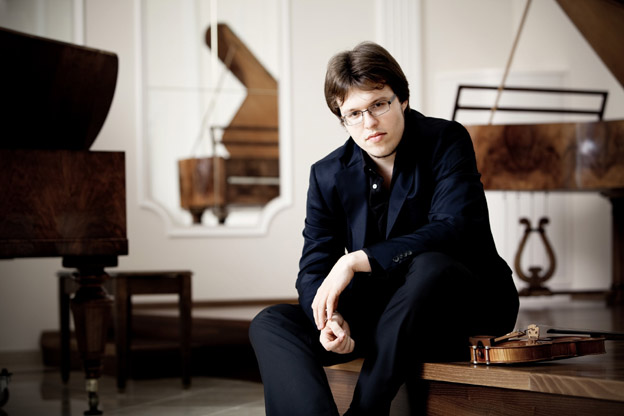
Thomas Albertus Irnberger
(c) Irène Zandel
Do you perhaps intend to focus solely on the viola now, and will we soon see you playing it in concert? Or was that a one-off? Do you plan on playing more viola repertoire?
I will continue to play both violin and viola. The Brahms viola sonatas aren’t my first foray into the viola repertoire on SACD. With Lilya Zilberstein and David Geringas, I recorded the Brahms piano trios and his clarinet trio in the viola arrangement. The recording was so successful that my producer at Gramola, Mr. Winter, requested the viola sonatas.
I’d like to record Hoffmeister, Telemann, and Stamitz on the viola, and Martinů’s Viola Rhapsody is also a dream come true.
Does a viola have a different sonic character for you? How do you perceive the difference between your two instruments?
The violin sounds silvery, bright, and radiant, while the viola sounds dark, full, and similar to the human voice.
And finally, would you tell us which viola you used to record this album? Are the famous violin makers also the most prominent viola makers?
Most outstanding violin makers are also equally wonderful viola makers; just think of Jacobus Stainer, Andrea Amati, Antonio Stradivari, and so on. My viola is a work by the Cremonese master Lorenzo Storioni (1744–1816).